
Welcome to the application for the NSF Center for Mechanical Control of Chemistry (CMCC), International Research Experience for Students (IRES) program. In this IRES program, students will carry out fundamental research as a full member of a research group at the University of Birmingham. In addition to research, students will participate in professional development and science communication in collaboration with the Science History Institute in Philadelphia, PA.
Professional Development Highlights:

Students in the NSF CMCC IRES Program will interact across our multi-institutional center via team-based projects, and will receive personal mentoring from multiple faculty and graduate students.
Students in our IRES Program will receive the following support:
This is a competitive program open to students in chemistry, physics, materials science, chemical engineering, or mechanical engineering majors (or closely related fields) enrolled in 4-year U.S. colleges and universities who have completed at least their first year with a 3.0 GPA or better. Two letters of recommendation will also be required. Students should not be in their final year of study (i.e. graduating before the NSF CMCC IRES Program begins). We especially encourage applications from students who have previously participated in the NSF CMCC or another REU program. Students must be US citizens or permanent residents.
To complete the application on the next page, you will need to provide:
The following research topics are available to REU students in this program:
Multi-Gram Production of Peptides and Depsi-Peptides Through Milder, Scalable Mechanosynthesis (UB PI: Friščić; CMCC PI: Speight)
This project is exploring Resonant Acoustic Mixing (RAM), a recently emerged “media-free mechanochemistry” technology, as a way to conduct scalable, cleaner and safer synthesis of pharmaceutically-relevant peptide targets. While conventional peptide coupling reactions are hindered by relying on toxic solvents such as dimethylformamide (DMF) and other non-sustainable reagents, the proposed mechanochemical synthesis route aspires to make such targets accessible in the absence of bulk solvents, and in a way that is scalable – which will be tested by targeting a synthesis on a scale of at least 100 grams. Students will learn the fundamentals of mechanochemistry and peptide chemistry, as well as advanced techniques to enable reaction scale-up, reaction monitoring in real time, as well as sustainability metrics for these systems. These skills will benefit students aiming for careers in the biopharmaceutical industry, sustainable synthesis, and process chemistry development.
Understanding the Scale-Up of Twin-Screw Extrusion (TSE) Processes from R&D to Commercial Manufacture Scale (UB PI: Crawford; CMCC PI: Speight)
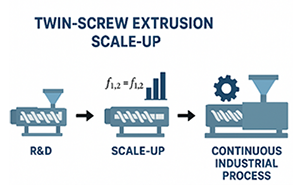
Twin-Srew Extrusion (TSE) has transformed mechanochemistry by proving that solvent-free, continuous synthesis is both industrially feasible and capable of significantly reducing the Global Warming Impact of chemical manufacturing. Although widely used in industies, such as polymer processing and pharmaceuticals, understanding how to scale mechanochemical porcesses from laboratory to commercial production remains limited, with current approaches relying heavily on trial and error. This project will address this critical gap by investigating the scale-up of key mechanochemical reactions previously established in the Speight and Crawford groups. Unsing Design of Experiment (DoE) software for the first time in this context, the project will analyze process trends and develop predictive models for scaling between small, medium and large TSE systems. The outcome will be a logical framework for continuous industrial-scale reactive extrusion, reducing reliance on empirical methods. Students will gain expertise in large-scale sustainable synthesis and advanced process optimiztion.
Elucidating the Fundamentals of Mechanocatalysis (UB PI: Friščić; CMCC PIs: Batteas and Mack)
This IRES project will enable the student to advance the understanding of catalysis under mechanochemical conditions. Mechanochemical techniques have been found to enable catalytic reactions that are more efficient and/or can be designed in a different way compared to conventional solution-based processes – such as mechanocatalysis, where the source of catalysis is the reaction vessel itself. Understanding such catalytic processes will enable the design of more efficient, scalable reactivity, and will rely on the development and use of specially designed reaction vessels, with student gaining first-hand experience in surface chemistry, mechanochemical synthesis, and advanced surface spectroscopy techniques such as X-ray photoelectron spectroscopy (XPS).
Green Synthesis and Solid Form Control of Environmentally Benign Biologically Active Molecules (UB PIs: Crawford and Michalchuk)

The solid (crystal) form of agrochemicals greatly influences both their effectiveness and environmental impact. This project aims to design solid forms that maximise potency while minimising long-term effects on soil and pollinators. Conventional trial-and-error methods are solvent-intensive and unsustainable, so we will develop innovative mechanochemical techniques, using mechanical force instead of solvents, to synthesise agrochemicals with precise solid form control. Using advanced time-resolved in situ analytics (e.g., X-ray diffraction and spectroscopy) and supported by AI and quantum chemical modelling, the project will uncover how solid form affects agrotoxicity, environmental stability and real-world efficacy. Laboratory studies will be complemented by toxicity and biodegradation assessments. This research will pioneer sustainable agrochemical manufacturing methods, with insights transferable to the pharmaceutical and food industries.
Computational Studies of Solid-State Transformations Under Uniaxial Strain (UB PI:Michalchuk)

The elementary mechanisms that underpin mechanochemical reactions remain poorly understood. Specifically, it is not well understood how different mechanical strains influence the reactivity of solid-state materials. This project aims to bridge that gap using solid-state density functional theory (DFT) simulations to model how uniaxial mechanical strain influences chemical reactivity in crystalline materials. We will systematically study different types and orientations of dynamic and static uniaxial strain and compare their effects on reaction pathways, energy barriers, and electronic structure. By analyzing changes in vibrational dynamics and crystalline and molecular charge density, we will identify which strain conditions most significantly enhance or alter reactivity. The ultimate goal is to establish a structure-informed framework for predicting and designing mechanical strains that accelerate desired transformations. This research will provide fundamental insights into mechanochemistry and enable more efficient, targeted approaches for sustainable chemical processes
Using Real-Time Spectroscopy to Understand Mechanisms of Bulk Mechanochemical Reactivity (UB PI:Friščić; CMCC PIs: Batteas and Felts)

Mechanochemical reactions present a complex reaction environment, in which continuous mechanical energy input leads to a wide variety of mechanical and thermal inputs, resulting in changes in chemical and crystal structure of participating substances. Understanding these processes requires real-time observation of how mechanochemical reactions evolve with time. This project will enable the student to contribute to the fundamental understanding of mechanochemical processes by using advanced spectroscopy and thermal monitoring techniques (Friščić), to follow the course of transformations taking place using Resonant Acoustic Mixing (RAM) – an emergent mechanochemical technology that is noted for its scalability. The results will be paired with modeling of particle-particle interactions mechanics (Batteas, Felts), to provide an integrated understanding of how mechanochemical reactions work.
Photoextrusion - Scalable, Continuous, Solvent-Free Photochemistry (UB PI: Crawford )

Mechanochemistry, using mechanical energy to drive chemical reactions, offers a sustainable alternative to traditional synthesis by minimising or eliminating solvent use. Recent advances in twin-screw extrusion have enabled mechanochemical processing at multi-kilogram per hour scales, paving the way for industrial adoption. This project takes the next leap by pioneering photoextrusion, the first example of continuous, solid-state photochemistry. By integrating light irradiation directly into the extrusion process, we will explore how mechanical force and visible light synergistically drive new reactivity. The research will focus on continuous photocycloadditions and photocatalyzed C–C bond-forming transformations, achieving solvent-free synthesis at scalable throughput. This project establishes a new paradigm for sustainable photochemical manufacturing in the solid state, overcoming batch limitations of photo-ball milling. It offers the opportunity to develop cutting-edge technologies with broad applications across chemical, pharmaceutical and materials sectors.

Mechanochemistry, which uses mechanical energy to drive chemical reactions without solvents, has shown great promise for sustainable manufacturing. Twin-screw extrusion now enables continuous mechanochemical synthesis at multi-kilogram per hour scales, making it attractive to industry. However, most advances rely on metal-based catalysts, despite over 90% of chemical processes being catalytic. Direct mechanocatalysis, where the reactor surface acts as the catalyst, has proved effective for metals but has not yet been successfully adapted to organocatalysts. This project will pioneer innovative methods to immobilise organocatalysts directly onto extruder screws, enabling their use in continuous solid-state catalytic transformations. You will investigate new coating and binding strategies and evaluate their performance in mechanochemical reactions. By expanding mechanocatalysis beyond metals, this research aims to open new avenues for sustainable, scalable chemical synthesis and broaden the industrial potential of mechanochemistry.


This material is based upon work supported by the U.S. National Science Foundation under cooperative agreement: 2023644 (Phase I) and 2303044 (Phase II). Any opinions, findings, conclusions, or recommendations expressed in this material are those of the authors and do not necessarily reflect the views of the U.S. National Science Foundation.


